
Across India, Singapore, and Australia, finance teams are under more pressure than ever to move fast without losing control. GST filings, SST and BAS obligations, multi entity reporting, and investor level scrutiny all land on the same desk. Many CFOs in the region are still running finance on a mix of standalone accounting software, spreadsheets, and manual reconciliation, which slows down decisions right when speed matters most.
At AppGlide, we work with finance leaders across India, Singapore, and Australia as the official Priority ERP partner for the APAC region. This guide breaks down what financial management in ERP actually means, the core modules a CFO should expect, and the questions worth asking before choosing a system. If your finance team is still stitching together disconnected tools, this is a good place to start.
What financial management in ERP really means
Financial management in ERP is the set of finance, accounting, control, reporting, and planning capabilities that let a company manage its money from one connected system, instead of many disconnected ones.
It brings together the general ledger, accounts payable, accounts receivable, budgeting, cash flow, fixed assets, tax, and reporting, and links all of it to what is happening in sales, procurement, inventory, production, projects, and payroll. For a CFO running operations across two or three APAC markets, this connection is what keeps the numbers trustworthy as the business grows more complex.
In practice, financial management in ERP is how finance stays in control of a business that no longer fits neatly into spreadsheets. Every transaction is tied back to the business event that created it, so nobody has to reconstruct the story manually at month end.
Why standalone accounting software falls short in India and APAC
Standalone accounting tools handle the basics well: invoices, payments, journal entries, bank feeds, and financial statements. What they cannot do is connect finance to procurement, sales, CRM, and production in real time.
This gap shows up quickly for growing companies in India and APAC. A finance team running GST reconciliation in one tool, sales orders in another, and inventory in a third spends hours every week importing, checking, and correcting data before any real analysis can begin. An ERP finance module removes that friction by applying accounting logic at the point the transaction happens, whether that is a sales order in Mumbai, a purchase order in Singapore, or a service invoice in Sydney.

Why centralised financial data matters for decision making
When financial information sits scattered across accounting software, spreadsheets, CRM, procurement, banking, and payroll systems, finance teams spend most of their time reconciling numbers before they can even start analysing them.
A well configured ERP creates one financial data structure covering customers, vendors, tax, payments, assets, cost centres, currencies, and reporting. For a CFO managing entities in India, Singapore, and Australia at once, that structure is what makes it possible to tell whether margin pressure is coming from pricing, procurement cost, freight, currency movement, or an inventory issue, rather than guessing.
Why financial reporting quality matters more than ever
Reporting is where ERP becomes visible to the rest of the leadership team, so it needs to be timely, accurate, and traceable back to the original transaction.
A modern ERP pulls data directly from sales, purchasing, inventory, operations, payroll, and finance into a single system, which makes reporting faster to produce and easier to audit. It also gives finance and business leaders a live view of cash flow, profitability, cost, and revenue, which is especially valuable for boards and investors reviewing performance across multiple APAC entities in different currencies.
Core financial management modules every ERP should include
A dependable ERP finance system typically brings together the following modules. Together they automate financial processes, strengthen cash flow management, support regulatory compliance, and give CFOs the insight needed for both day to day and strategic decisions.
General ledger
The general ledger is the backbone of the finance system, pulling in postings from subledgers, operational modules, manual journals, accruals, allocations, depreciation, and adjustments into one official record. A well built ERP general ledger supports multidimensional accounting across legal entity, department, cost centre, location, project, and business unit, which matters for companies managing statutory reporting in India alongside management reporting for a regional or global parent company.
Accounts payable and receivable
Accounts payable and receivable directly shape cash flow, working capital, vendor relationships, and how quickly the books close. When AP and AR are connected to procurement, sales, inventory, contracts, banking, tax, and approval workflows inside the ERP, finance controls liabilities and receivables from the moment they are created, rather than discovering issues weeks later.
Cash and banking management
Cash management is not only a treasury task. It touches supplier relationships, credit risk, working capital, and operational continuity. An ERP that connects expected inflows from AR, expected outflows from AP, payroll obligations, open purchase commitments, tax liabilities, and bank balances gives a far more realistic view of upcoming liquidity than bank statements alone, which matters when a business is managing accounts across multiple currencies in the region.
Fixed asset management
Fixed asset management covers the full lifecycle of capital assets, from acquisition and capitalisation to depreciation, transfer, and disposal. For capital intensive sectors common across India and APAC, such as manufacturing, logistics, and construction, accurate asset tracking has a direct effect on balance sheet integrity, tax reporting, and operational planning.
Budgeting and forecasting
Budgeting and forecasting tools let finance teams plan, monitor, and revise financial expectations using actual operational data rather than last year’s assumptions. This should support budget versions, department level budgets, project budgets, and budget versus actual reporting, broken down by account, cost centre, product, or entity.
Tax and multi currency management
This is where regional complexity becomes very real. A company operating in India, Singapore, and Australia is managing GST, SST, and GST or BAS obligations at the same time, often across multiple currencies. The ERP tax engine should handle tax codes, calculations, withholding tax, exemptions, and local reporting requirements, while multi currency functionality manages transaction, functional, and reporting currencies along with exchange gains, losses, and revaluation. Consistent, system driven rules take the guesswork out of applying the right treatment on every invoice and every close.
AppGlide configures Priority’s Financial Management module with the tax and currency rules relevant to each APAC market we support, so finance teams are not left building workarounds outside the system.
Multi entity and intercompany management
Running multiple legal entities across the region means each one needs its own ledger, currency, tax rules, and statutory reporting, while head office still needs consolidated, group wide visibility. A capable ERP allows each entity to keep its own books while sharing common master data, reporting dimensions, and approval structures, so local compliance does not come at the cost of corporate control.
Financial reporting and analytics
This is what turns the ERP from a system of record into an actual management tool. A strong reporting layer should support financial statements, dashboards, variance reports, cash analysis, profitability views, ageing reports, and drill down to transaction level detail, so finance can move from a headline number to its root cause in a few clicks.
The real benefits of ERP driven financial management
Beyond the module list, the value of ERP shows up in how finance teams actually work day to day.
The numbers back this up. The Asia Pacific ERP market is on track to grow from roughly USD 14.5 billion in 2026 to USD 25.4 billion by 2031, expanding at a compound annual rate of over 12 percent, among the fastest growth rates of any region globally. That pace reflects how many finance teams in India, Singapore, and Australia are actively moving away from fragmented, spreadsheet-heavy setups right now.
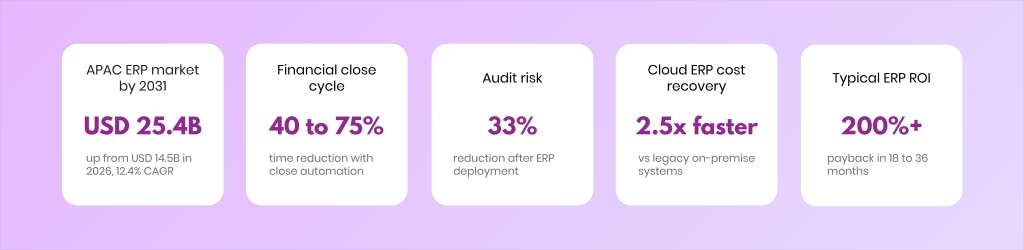
The payoff for making that move tends to be concrete. Independent research from Nucleus Research has found that ERP-driven close automation can cut financial close cycles by 40 to 75 percent and reduce audit risk by roughly a third, while cloud ERP deployments typically recover their costs about 2.5 times faster than legacy on-premise systems. That same analysis puts the typical ERP payback period at 18 to 36 months, according to Panorama Consulting Group, with many organisations reporting a return on investment well above 200 percent once the system is fully adopted. For a CFO weighing whether a connected finance platform is worth the change, these are not abstract efficiency gains. They translate directly into faster decisions, lower compliance risk, and a close process that stops eating up the first week of every month.
Faster, less manual processes
Routine work such as invoice matching, approval routing, recurring journals, accruals, depreciation, and bank reconciliation runs through controlled, automated workflows, so finance teams spend their time on exceptions rather than repetitive data entry.
Real time visibility instead of after the fact reporting
In a fragmented setup, problems tend to surface only after new commitments have already been made on outdated numbers. A connected ERP tracks revenue, costs, margins, receivables, payables, and cash as the business moves, so a CFO can act on a cash gap or margin issue while there is still time to change course.
A shorter, calmer month end close
A slow close is usually a symptom of missing approvals, unmatched invoices, unreconciled bank items, and last minute spreadsheet fixes. Automated posting rules, subledger controls, bank reconciliation, and intercompany matching bring more discipline to the process, which matters when a regional finance team is trying to close India, Singapore, and Australia books on a consistent timeline.
Stronger compliance and audit readiness
Approval workflows, segregation of duties, user permissions, and audit trails are built into daily financial activity rather than bolted on afterward. Auditors can trace a balance back to its source transaction, supporting documents, and approval history, which reduces the risk of undocumented adjustments or inconsistent processes across entities.
Better forecasting grounded in real operations
Because finance is connected to the modules that actually drive financial outcomes, forecasts can be built on real commitments and current business conditions rather than historical averages alone. That makes decisions about hiring, pricing, capital spending, and expansion more defensible.
A system that scales with the business
As a company adds entities, products, or markets across the region, the finance system needs to expand without adding a pile of manual workarounds. A well implemented ERP keeps controls, reporting dimensions, and approvals consistent even as the business becomes more complex.
Three practices that determine ERP success
- Data integrity and governance: define clear ownership for the chart of accounts, cost centres, vendors, customers, tax codes, and approval hierarchies, with consistent naming and regular master data reviews.
- Process optimisation: map procure to pay, order to cash, record to report, and close processes before configuration, so the ERP is built around a clean workflow instead of replicating old habits.
- Reporting and adoption: assign clear owners to each report, lock down KPI definitions, and provide role based training so managers actually trust and use the dashboards instead of rebuilding numbers in a spreadsheet.
What to evaluate before choosing an ERP finance system
Selecting an ERP for finance is about more than a feature checklist. For businesses in India and APAC, three areas deserve particular attention.
Banking and payment integration
Cash visibility depends on how quickly data moves between the ERP, banks, and payment providers. The system should support bank statement imports, reconciliation rules, payment file generation, and secure payment workflows, including local formats for companies working across multiple banks or countries in the region.
Scalability for growth and market expansion
A finance system should support the business a company is becoming, not just the one it is today. That means being ready to onboard new entities, currencies, and tax jurisdictions while preserving group level visibility, consolidation, and consistent governance, whether the next step is a new Indian state, a Singapore subsidiary, or an Australian acquisition.
Implementation partner expertise
An ERP finance rollout depends heavily on the partner delivering it. Chart of accounts design, data migration, tax configuration, and close process design all require real finance domain knowledge, not just technical configuration skills. This is where a regional implementation partner with local market experience makes a measurable difference to how smoothly the rollout goes.
Common challenges in ERP financial implementation
Even a strong ERP can run into friction during rollout. The three most common issues are worth planning for early.
Data migration and configuration
Balances, customer and vendor records, open receivables and payables, bank accounts, fixed assets, and tax codes all need careful validation before go live. If figures do not reconcile at launch, user trust drops quickly, and adoption becomes an uphill battle.
Change management and adoption
An ERP finance rollout changes how people work day to day, often removing informal workarounds teams have relied on for years. Role specific training for AP teams, controllers, FP&A, and department managers is what determines whether the new system becomes the real way work gets done, or just another tool people route around.
Cost and timeline discipline
Projects run over budget or schedule when scope is unclear or decisions get delayed. Clear ownership, realistic testing cycles, and disciplined milestone tracking matter as much as the software itself.
How AppGlide and Priority ERP support finance teams across India and APAC
As the official Priority ERP partner for India, Singapore, and Australia, AppGlide helps finance teams move away from disconnected tools and manual reconciliation toward one connected system.
Priority’s Financial Management solution brings accounting, billing, reconciliation, and reporting onto a single platform alongside operational data from sales, procurement, and inventory. That means journal entries, invoice processing, bank activity, and ledger updates run with tighter control and far less spreadsheet dependency at month end.
For businesses exploring AI assisted finance workflows, Priority’s aiERP builds AI directly into everyday ERP tasks, while Priority’s cloud ERP gives growing India and APAC businesses a scalable foundation without heavy on premise infrastructure. Regional tax and compliance needs are handled through Priority’s localization capabilities, which AppGlide configures specifically for the markets our customers operate in.
AppGlide’s role is to bring that platform closer to how finance teams in this region actually operate, from GST and e-invoicing requirements in India to multi currency reporting for regional headquarters in Singapore and Australia. If your finance team is still spending the first week of every month reconciling numbers instead of analysing them, that is usually the clearest sign it is time for a connected ERP. Book a demo